Sunday, April 28, 2013

Art Themes ~ Orbs

Ruby's Spa at the Edgefield Lodge is quite unique, not only in its history but its decorum.  These wonderful orbs docorate the entire campus of the lodge but are particularly numerous at the spa.  Troutdale, OR.

Every orb is uniquely painted or adorned and are made of cast metal...I'm assuming cast iron or bronze. This one looks flower-like, but the others can be a little challenging to figure out. Ruby's Spa, Troutdale, OR.

Many of the orbs have the swirled metal at the base. Ruby's Spa, Troutdale.

This one looks like an artichoke. Ruby's Spa.

Some aren't painted as much as adorned. The details are what make a motif. These appointments definitely make the Edgefield Lodge a truly unique experience.

A weather vane-looking orb atop the gate structure at Ruby's Spa. Some of these look as if there was some significant painting effort involved.

An orb with a celestial feel to it...at the gate of Ruby's Spa. Troutdale, OR.

This orb was on the roof of the bar/lounge next door to Ruby's Spa.

Sunday, April 21, 2013

Statuary ~ Arches

Dedicational arches have been around for thousands of years, dating back to ancient Roman times.  This arch was commissioned in honor of Cesar Chavez.  SJSU.

This is not a mural but a mosaic of Gandhi, an advocate of non-violent resistance.  These detailed mosaics on the Chavez Arch are made from very small shards of glass and tile.  SJSU.

This is Delores Huerta.  She helped Cesar Chavez in founding the United Farm Workers and furthering the civil rights of farm workers.  The Chavez Arch, SJSU.

There are no explanatory placards on the Chavez Arch, so it is difficult to figure out some of the mosaics.  Notice the skeleton in the lower left.  SJSU.

Cesar Chavez, a hero of the Latino community in California, rallied for farm workers' rights and ultimately formed the United Farm Workers.

The Chavez Arch at San Jose State University.

Art ~ Digital Media

I knew this image would not give the original work justice.  The mottling from the sunlight through the shade trees throws off the metering of the camera.  I was in P&S (point and shoot or Program mode) when I should have taken some time in a different mode. This is an exoplanetary celestial dial map made from multiple mahogany veneers.  The celestial dial map allows one to select a month of the year 2012 and display those known and newly discovered exoplanets based on NASA's effort with the Kepler space telescope and other programs.The design artwork was cut and etched with a laser.  When SJSU students can't get machine time on campus they go to the tech shop around the corner.  This was absolutely beautiful and visually engaging.  SJSU.
 
This amazing contraption is the brainchild of an art major with a concentration in Digital Media.  I initially thought that this was a project of a mechanical engineering student.  This X-Y plotting device connects to the internet and streams real-time data from the USGS Twitter feed on earthquakes.  It then marks in the sand those epicenters.  The plotter was made from materials from many sources...notice the framing by 80-20.  Art Department at SJSU.

Each divot in the green sand is the epicenter of an earthquake greater than magnatude 1.0.  The plotter streams the degrees and minutes data from the USGS Twitter feed.  The magic sauce is the algorithm that converts that data into the sand map's X-Y coordinates.  San Jose State University.

A better-exposed image of that celestial dial.  Art majors with a concentration in Digital Media border on majors in engineering.  San Jose State University.


Pictorial Art ~ Murals

The Dirty Brushes art club is hard at work making the drab blue construction barrier around the student union renovation more appealing at SJSU.  The barricade was painted blue to discourage graffiti. 

One good example of the many works on Portrait Row.  On this day most of the murals were too distorted with the dappled shading of the nearby trees to give them justice.  The Dirty Brushes artists emulate the styles of the original self-portrait artist in their works.  Proximate to the Art Department at SJSU.

Stepping back to see the work in progress.  These pictorial artists are challenged with reproducing the portrait in that dappled sunlight that can throw off the color and shading of the effort.  Near the Art quad at SJSU.

Working on the finishing touches.  Art majors have to take several semesters of anthropology, world language, and photography.  Near the Art Department of SJSU.

Pictorial art warriors hard at fun.  This kind of work is an effort of passion and not even close to a definition of "work."  San Jose State University.

Wednesday, April 17, 2013

Art ~ Temas Oscuros

We all live around artistic activity.  My roommate, Greg, is an artist.  He paints, draws, and is a musician. All of these works are his.
 
This 10.5" x 13.5" acrylic is a self-portrait. He invoked the expressionism style with this work.

A 13.5" x 17.5" acrylic of a dark theme in the style of expressionism as opposed to impressionism. Human skulls and skull symbols have been used in a variety of different works of art, art styles, and cultures for much of history.

This 15.5" x 21.5" work is a color pencil drawing of a photo from a National Geographic issue. Notice the tear in the left eye. She's in mourning. Pencil drawings of this style take large amounts of time to complete. Layers and layers of shading are required...along with a lot patience.

This was a cropped pencil drawing of a full portrait photo. This smaller work of 4" x 8" actually took longer to produce than the "Mourning Lady" above.
 

Sunday, April 14, 2013

Shorty ~ My Neighbor

And now for a post that is not so artsy-fartsy...
 
Her name is Shorty.

She is a little black squirrel that lives around my apartment complex.

I call her Shorty because she's short a tail.
 
A closeup shot of my neighbor, Shorty.

Sunday, April 7, 2013

Art ~ Dia de los Muertos

This interesting sheet metal statue was outside of an art studio in Hood River, Oregon. I'm not sure if the red rust was part of the creation process or just the effects of the environment, but it definitely compliments the piece.

Zooming out we can see that she is a mermaid with a seahorse friend. On this day, this art studio in Hood River had a live band singing folk music and numerous works on display inside.

A window painting inside that Hood River art studio. There was some kind of Dia de los Muertos theme going on inside the studio as I noticed on that day a display area with masks and paintings.

A piece of wall art at the Rabbit's Foot Meadery in Sunnyvale, California. The meadery is a nondescript place in the middle of a commercial/industrial area in the Silicon Valley. This piece reminded me of the Day of the Dead.

Saturday, April 6, 2013

Stutuary ~ Tribal Chief

This statue was the first thing I encountered at the McMenamin's Edgefield resort lodge in Troutdale, Oregon. The slightly oversized head makes it a bit abstract and interesting.  The resort is on 74 acres, has numerous bars and lounging areas, and a very nice restaurant.  We planned to stay only an hour or so to eat breakfast, but we ended up staying over half the day. This is just a few minutes away from the major Portland metropolitan area.

This shot is a particularly nice bust shot. The verdigris patina adds to the expressiveness. There were other statues and works of art all over the lodging grounds.  The experience was almost like that of a treasure hunt or a mystery adventure. I never knew when and where I would find something...it was truly and interactive and engaging experience. Troutdale, OR.

It looks tribal, especially with the plant in the head as a headdress. And there seems to be an expression on his face. I imagine him to be some kind of tribal chief or shaman looking up to the gods in some sort of ritual offering. Troutdale, OR.

In its display setting, it's the centerpiece in the small auto carousel (or roundabout) at the entrance to the main building of the Edgefield lodge. This was just one of countless pieces of art throughout the lodge and surrounding grounds. At times I felt as if I were in a labrynth or maze. I could have spent much more time there. I definitely plan to return. Troutdale, OR,

Saturday, March 2, 2013

Context - Granite

The vegetation at Castle Crags is not this deeply green and lush. This image is slightly underexposed. But I like it.

Even though this image is slighty overexposed, it is truer to the hue and color of the flora of Castle Crags...Near Shasta.
 
If you look closely, you will see "faces" on the rock.  Humans are one of the few creatures that look for patterns, facial patterns specifically, in their environment. Do you see them? Near Shasta.
 
A different angle of the "faces" in the rock. One of them looks like Treebeard. Castle Crags.

The clouded and majestic Shasta with the silhouette of forest in the foreground.

A different angle of Shasta with some some symmetry in the foreground.

Now Shasta with some rock and trees for balance. 
 
This is a slab of rock balanced precariously on the edge of a granite structure. It looks out of place, even from this angle, yet nature put it there.  It may not look like it, but that rock weighs at least two thousands pounds. Near Shasta.
 
A different angle of that "precarious" rock. Near Shasta.

This angle exemplifies even more the precarious position of our prodigal stone. Near Shasta.

And yet a different angle of the stone and its neighborhood.  Shasta area.

Look closely and you'll see a sleeping giant in the rock. The peak at Castle Crags.
 
The sleeping giant from this angle looks a bit anguished. The peak at Castle Crags.
 
A different angle of the giant. Castle Crags.
 
And yet a different angle. This granite is big. Look at the face. Those are full-sized trees. Near Shasta.
 
A closer shot of the sleeping giant. Near Shasta.
 
If I had moved a bit to the left, the artificial (man-made) trail would not have been visible in this shot. Still, this is a decent shot of granite and vegetation. Castle Crags.
 
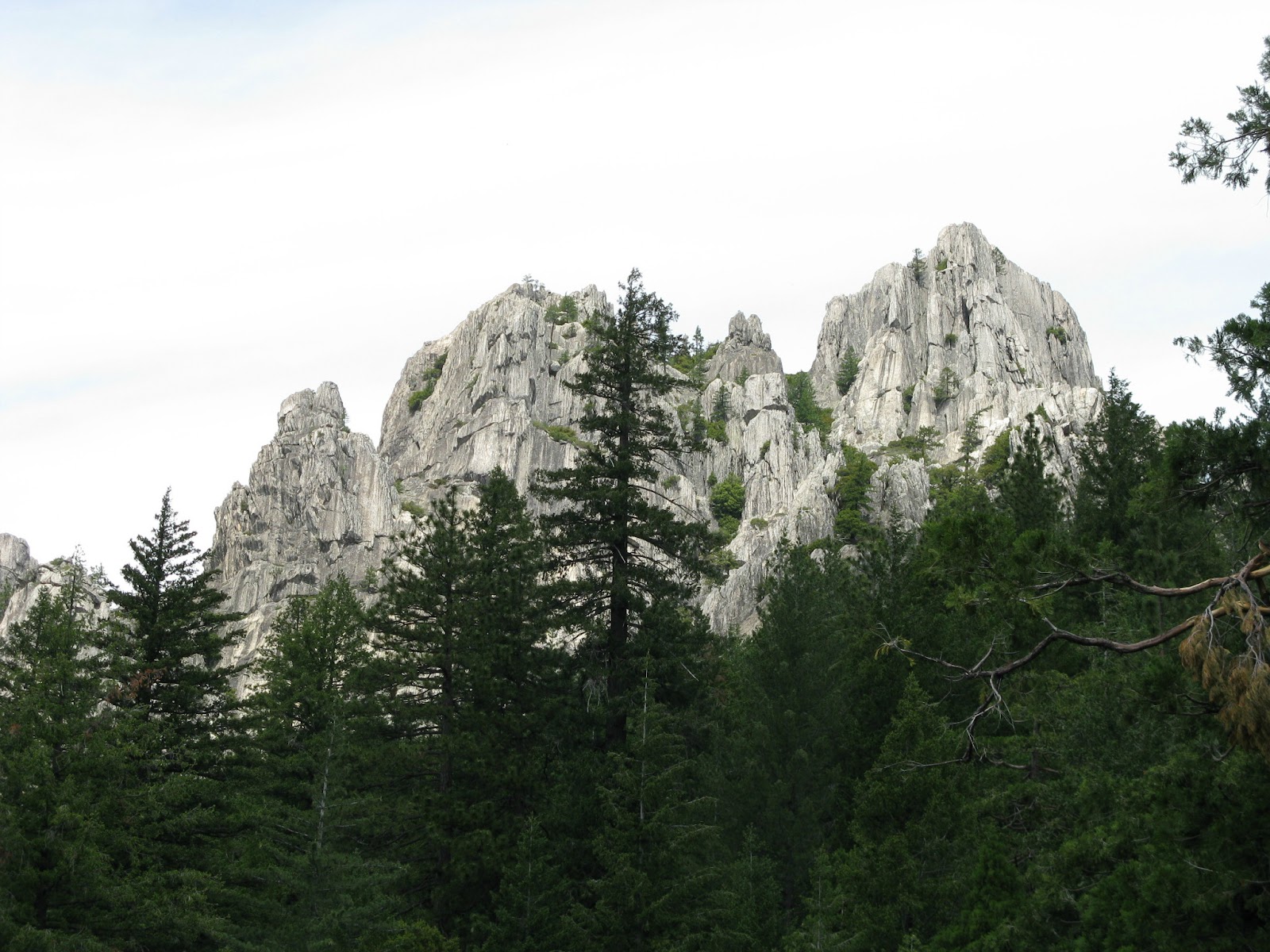
The granite formations at Castle Crags are equaled by those only of Yosemite. They are, quite frankly, confounding.
 
A granite outcrop that is both beautiful and mysterious. Castle Crags.
 
This is on the face of the sleeping giant. The elevation is high. Near Shasta.
 
From the face of the sleeping giant...three peaks of granite. Castle Crags.
 
On the face of the sleeping giant...this critter passed by me completely relaxed. My adrenaline was running high, but his wasn't. This fellow had six rattles, a button, and a mantle. That put him at 3 or more years old. And if you look closely, you will see the forked tongue working. It's interesting to note that granite formations degrade.  Look at this picture and you will see the various stages. There are rock-sized, pebble-sized, and smaller-sized granite.  The sand that you see is not sand at all, but granite that has degraded over time from the evironment, sun, and foot traffic from various animals. The technical term for this is decomposed granite. This is an excellent shot of a western rattler. Castle Crags.
 
A perspective of granite from Castle Crags.